Reading Notes on Guitar
Fundamental Changes makes some of my favorite guitar books on the planet. They're always informative, chock full of cool riffs, and have great teachers doing the writing.
In addition to their books, they also have a great website full of lessons. If you don't know how to read music, you should check out this post which is very helpful in getting started.

141 Jazz Guitar Licks - Essential Lines and Patterns
Matt Warnock is one of the best resources for jazz guitar lessons. His website is jam packed with essential lessons for the genre, and they generally are in depth posts. I've mentioned him many times in the Six String Sunday newsletter, and today I wanted to link to one of my favorite posts of his. Click the link below to head to his 141 Jazz Guitar Licks post. Not only are there great jazz licks to learn in this lesson, but Matt gives you the background about how and why you should learn these licks, and how to change them to be used in your own playing.
What do you wish you knew when you first started?
Right now we have access to lifetimes worth of people who have played the guitar. We can learn what pushed them farther along on the path when trying to get better, and we can also learn what mistakes they ran into. In this post I detail what I wish I knew when I first started playing guitar.
Right now we have access to lifetimes worth of people who have played the guitar. We can learn what pushed them farther along on the path when trying to get better, and we can also learn what mistakes they ran into.
That’s the whole basis of what Chasing Sound tries to do each and every day. Provide feedback from nearly 20 years of playing guitar, and reading about guitar every single day. The funny thing is, it’ll always be a work in progress, because while we can try and master one part of playing guitar, there’s always something new to learn.
Here are a couple of the things I wish I knew when I first started years ago.
Gear doesn’t matter at first
When you’re starting out, it’s always good to have a decent guitar, but you don’t have to have an expensive setup. What is important is that whatever first guitar you do choose, you get it set up to play well. Make sure the action is low, and you have a new set of strings on there.
I love buying new guitar gear, including guitars, amps, and especially effects pedals. While they do spark new ideas and do kickstart your want to play and practice, you could really get SO many things done with just one guitar, and a practice amp.
Figure out if you want to start on acoustic or electric guitar at first, and go from there. If you’re just getting started, check out the other posts in the Back to Basics series right here on Chasing Sound.
Use what you’re practicing in a musical context
We’re not robots as guitar players. As musicians, we’re as far from that as possible, but I’ve often seen students practice scales up and down to a metronome all day. This sounds like a depressing scene.
When you first start learning a scale, chord or technique, try and use it in a musical context as soon as you can. If you’re learning the Mixolydian mode, choose a key to practice it over. Put on a backing track if you’re learning a new riff and try to see how it fits in an actual song.
If you get on stage, you’re not going to be running scales up and down the fretboard. But you will be playing songs. If you want to not sound so scalar, practicing what you learn in a musical context is key.
Try and jam with other musicians
One of the easiest ways you can try out new ideas and become a better musician is by playing with other people. Find a couple of people you can jam with, find a practice space (whether that be at a rehearsal spot or someone’s house), and see how it goes.
You’ll find early on that you won’t always click with everyone, but that’s part of the fun. A good idea is to come in to the practice space with a couple of cover songs you want to play, and then go from there.
When you’re playing with other people, the biggest thing you’ll develop is your ability to listen. Try and play for the song, know when to take a lead, and know when to lay back. This’ll also help you be able to tell what key a song is in quickly, because a lot of times you’ll have to figure this out on the fly.
Spend time on the hard stuff and break things down
When I first was starting out, almost by accident I started playing more difficult songs right away, because I was in to technical bands. This turned out to be one of the best things for me, because it developed my playing so quickly.
If I tried to learn a difficult song, I wouldn’t get discouraged. Instead, I’d try to break ideas down into smaller chunks, and work on a couple of parts a day. I’d get the rhythm parts down first, then tackle some of the leads, and finally solos of a song.
You can even break more difficult riffs into just a bar or two so they become more manageable. Further, if you’re able to slow the riff down a bit, almost any riff becomes learnable.
Be as efficient as possible
Whether you’re focusing on speed, switching from open chord to open chord, or anything when it comes to guitar, focus on efficiency first. We only have so many notes to work with on any instrument, so you can imagine there are a number of ways to play chords and riffs.
Try and find the most comfortable and efficient way to play with your left hand, and then also focus on how you can work on your right hand. Whether that be economy, hybrid or alternate picking, there’s always a simpler way to play things.
Troy Grady over at Cracking the Code has made entire lessons on how the great guitarists use their right hand, and what goes into their picking mechanics.
If you’re looking to develop speed, be efficient, start slow, and build up gradually.
Know what you’re going to practice
One of the fastest ways you can progress on guitar is to know what you’re going to work on when you sit down. We all have those days where all we want to do is just sit down and jam, and those days are important.
If you really want to see progress though, try and develop a practice regimen where you can work on stuff every single day if possible. Try modes, picking, transcribing, theory, songwriting and more one day, and then switch it up the next.
Setting limits for yourself and knowing what you’re going to practice ahead of time will allow you to grow in leaps and bounds as a player.
Don’t count anyone out and listen to everything
From the person who’s graduated from Berklee, to the guitar player just starting out, we can learn from everyone. When we start out we might have knowledge gaps on our way to playing what we want to play. It’s possible watching a beginning guitar player you’ll find out a new way to play a chord you’ve been playing for years.
Watching someone who’s played for a long time, you might also find out a more efficient way to do something you’ve been playing forever.
When it comes to listening to music, you should try and give everything a shot. Don’t count out any genre. There are great guitar players no matter what style of music you’re listening to. The more styles you listen to, the bigger your musical vocabulary will grow.
Listening to this many styles of music will you give you a big advantage to use that hybrid of genres in your own music. It gives you an opportunity to create something new and exciting.
Don’t get hurt
If you’re just starting out you’re likely to experience some aches and pains while playing the guitar. If something is hurting you, take a break and give your hands a little time to recover.
If you pick your guitar back up and you’re still experiencing pain, go see your doctor to see if you injured your hands in any way. The good news is the longer you play, the easier it’ll get.
You might want to try starting playing out on an acoustic with heavier gauge strings. When you switch over to an electric, you’ll feel lightning fast.
Don’t give up
I remember being 16 and thinking that I’d never, ever be able to play barre chords. I was so upset and almost ready to hang up my guitar for good. I’m here to tell you close to 2 decades later, that I’m so glad I kept going.
Playing guitar and being in the musical community in general has helped me so much in life. It’s great to be able to read and write music, meet and play music with other people, and so many other benefits.
I urge you not to give up, and keep on plugging away when it gets hard. I can assure you playing an instrument, especially guitar, is worth what you put into it.
Have fun!
We put so many hours into learning an instrument to play songs and have fun. If it becomes not fun for any number of reasons, and they’re sure to present themselves throughout the years you’re learning guitar, don’t worry.
Guitar is a very special instrument. Once you play it, you’re likely to come back to it throughout the rest of your life. It’s not horrible to take a break from it every once in a while, and you might find yourself re-energized with a new love for music and playing after having been away from the guitar for a while.
Share your own stories
Guitar has shaped so many peoples lives, and changed them in a dramatic way. I hope these lessons from my own struggles help you on your path. If you think of anything that might help guitarists just starting out, feel free to share your story with me on Twitter or Facebook.

1% Better Each Day
Today's post talks about how you can get better on the guitar by trying out the 1% concept.
I Want A Parrot - a song that's been the bane of my existence over the past couple of months. I've always wanted to be able to play the super fast run at 1:31 of the Aristocrats' song I Want A Parrot. At first, I tried to learn the entire song, expecting to play like Guthrie Govan right away - which is futile. I felt defeated right at the 1:31 mark.
The song and that section filled my head for days, wondering why I couldn't make that section happen. Then I started thinking about 1%. How could I tackle that riff, and get better at it by 1% each day, ultimately accomplishing my goal.
You may think 1% is a small amount, but it really does add up over time. Last year we did the Song In September Challenge, and made a fun song, challenged ourselves, and learned a lot in the process. Other times we've watched guitarists work on sweep picking for 30 days and go from sounding terrible, to sounding like Yngwie Malmsteen. What do you want to accomplish in the next month, or year? In addition to setting huge goals, you should then break those goals down into smaller bite-sized chunks.
If you want to learn sweep picking, start with 2 string sweeps. If you want to get into jazz, write down all the chord types you need to learn, and practice one a day. If you're working on a particularly different section of music, break it down bar by bar, and play it cleanly until you can get it up to speed. Speaking of which, speed will come when your efficiency gets better. How can you play a riff more efficiently? The more you work on efficiency, the more you'll be able to crank that metronome's BPMs up.
One thing you can try is to set an incentive for yourself. If you try and get 1% better each day for three months, buy yourself a new guitar pedal. This is a fun way to get more invested in your learning.
How will you get 1% better each day?
Think about trying to get 1% better each day until the end of the year. What type of guitar player will you be then? Rather than getting all your practice in one day, spread it out in manageable every day practice routines. If you don't know what to work on, I'd be more than happy to help you create a practice schedule, answer questions and more. Reach out to me on Twitter, YouTube, or Facebook.
Join Chasing Sound's Six String Sunday
Subscribe to get the best guitar stuff the internet has to offer.

Five Questions
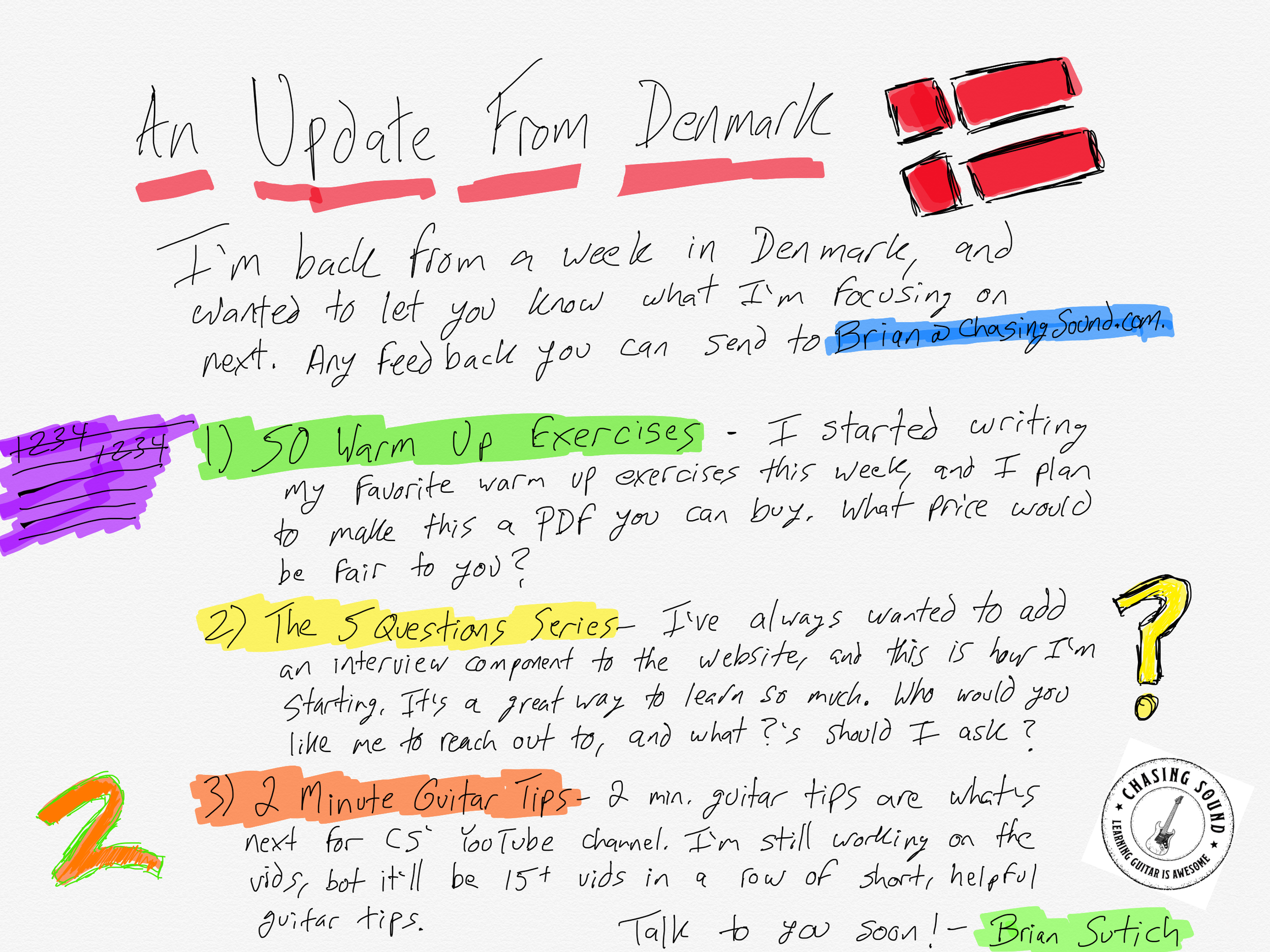
Today I’m announcing the Five Questions series. I’m already in contact with a number of guitarists, but I want to know who you’d like me to reach out to, and what you’d like me to ask them!
Chasing Sound is turning out to be so many things. A while back I even made a User’s Guide for all the places you could find Chasing Sound online.
Everything from lessons and more right here on this site, to Twitter, Facebook, Instagram, and on Anchor with Amped Up my guitar radio podcast each day.
I never tried to specifically model Chasing Sound after just one thing. I want a podcast where I can help you learn about cool guitar songs, and go behind the scenes. I like to be on social media so I can post fun images on Instagram, and reach out to you guys on Twitter and Facebook.
And the actual site itself, the one you’re reading right now, I always want it to be what you want to learn, mixed with the best a guitar mag could ever offer. I grew up reading Guitar Player and Guitar World, so I love a good guitar interview.
That’s why I want to add a new series to the site called Five Questions. The way I see it, I’d like to ask players 3 guitar questions, 1 general music question, and then 1 wild card question.
I already have reached out to a number of players, but this site is for you. Who would you want me to reach out to with five questions? Who and what do you want to know from your favorite players?
Let me know by reaching out on Twitter or Facebook. You can also e-mail me instead at Brian@ChasingSound.com.
As always, thanks for reading!

2 Awesome Guitar Products You Gotta Check Out
In today’s post I tell you about 2 awesome guitar products I’ve been checking out this week. If you want to get better on guitar, I have something for beginners, and another for more advanced players. Both are really helpful in progressing on guitar!
Wanted to let you know about 2 awesome guitar products I’ve been checking out this week.
The first is the new deluxe version of Mr. Fastfinger’s Exploding Guitar album. Here’s all the cool stuff that comes in the deluxe version:
Full backing tracks album + Isolated lead guitar tracks
6 Full tablatures and playthroughs videos
7 Bonus jam
3 Missing album tracks
3 Mika’s bedroom recordings from 1996 – 1997
Mika’s guitar playing is really unique, and he has a really interesting way of making songs. Check out his YouTube for more. I really enjoyed checking out his composing is recycling video. It’ll give you a new perspective on “stealing” riffs and making them your own.
If you want to pick up the new deluxe “Extravaganza” edition of Exploding Guitar, you can check it out here.

The other cool thing I’ve been checking out are the lessons from Darrell Braun. Darrell makes great YouTube videos that showcase all the cool educational PDFs he sells. I’ve been incorporating the warm-up PDF into my every day practice routine. He also has PDFs for color chords, easy arpeggios, fingerstyle guitar, jazz chords, and a lot more.
Check out his store here. If you want to get an idea of what his PDFs are like, check out his videos on YouTube.
I got inspired from checking out Darrell’s warm-up exercises, and from a previous post I wrote where I shared five of my favorite warm-up exercises to get your fingers going. Look for a new product from Chasing Sound soon that’ll give your fingers a real workout!

Photos via: Darrell Braun YouTube and / Mr. Fastfinger.net
Join Chasing Sound's Six String Sunday
Subscribe to get the best guitar stuff the internet has to offer.

16 ways to get better at guitar right now
It happens to the best of us. We fall into a rut, and don't know how to climb out of a soul sucking, lull in creativity. It's easy to become comfortable, after sitting down to practice, noodling, running over the same riffs. It's important to *just play* every once in a while, or play your favorite song, but if you want to move forward on the guitar, you have to be willing to shake things up.
Here are a bunch of different things you can do to get your guitar skills to another level.
It happens to the best of us. We fall into a rut, and don't know how to climb out of a soul sucking, lull in creativity. It's easy to become comfortable, after sitting down to practice, noodling, running over the same riffs. It's important to just play every once in a while, or play your favorite song, but if you want to move forward on the guitar, you have to be willing to shake things up.
Here are a bunch of different things you can do to get your guitar skills to another level.
Learn how to bend
Have you ever really listened to when you bend a guitar string? If you're trying to get a whole step bend, are you making it all the way? Sit down and practice, quarter, whole, whole and a half, and other bends. The easiest way to do this is to play your starting note, then play your target note, and then go back to your starting note and try to bend it up to the target note you just heard.
You should be able to get pretty close after a few tries. If you're bending with your ring or pinky finger, try and use your middle or index finger to give those weaker fingers a little support. It's a beautiful thing to be able to bend accurately. Practice this a little bit every day, and you'll also develop finger strength in the meantime.
Record yourself
I always talk about creating a lick library. Whether that be by writing your riffs down, or recording them, it's a really beneficial thing to have when you're writing songs. One other component you should add to your lick library is recording yourself via video.
This does a couple of things. First, you have a video version of the riff you recorded, so it'll be easier to see where you had your hands on the guitar neck, and this will also help you when you're trying to remember riffs. The other thing recording yourself via video accomplishes is that you can see how far you've come on the guitar. If you recorded yourself practicing a legato riff 6 months ago, and you find yourself recording a new legato riff today, you can see how much you've improved, and what needs work.
Practice a technique every day
While traveling recently my Lyft driver mentioned how he was trying to learn fingerpicking. Whether it be fingerpicking or any other technique (sweep picking, economy picking, hammer ons) it's important to practice that technique every day to make sure you're making progress.
Just like you wouldn't cram running or weightlifting into one day a week, the same thing goes for guitar. The practice every day thing is real. Not only for techniques, but for speed as well. If I find myself practicing something every day, by the end of the week I'll usually be able to see real gains, if not sooner.
Try to make music with two notes
I can't remember where I first saw this concept. I believe it was someone like Vai who even started with trying to play 1 note 30 different ways. If you're in a creative rut, it's easy to get better at guitar by trying to make 1 or 2 notes sound exciting.
Limiting yourself to two notes makes you really hone in on technique and accuracy. Plus, it's good mentally, because it'll force you to think of creative ways to play just two notes. Try them as a chord, using hammer ons, pull offs, with vibrato, bends, and more.
Don't practice bad habits
It's important to recognize that if you make a mistake or develop a bad habit on guitar, that you don't keep repeating it over and over again. One thing I've seen a lot of students do is practice sitting down. While this may be comfortable, it's likely that you'll be playing standing up. Whether that be at a show or another event, it's a good idea to try and practice good habits.
This goes for more than just practicing while standing up though. Some students hold the guitar in an awkward way, that doesn't give their fingers the optimal strength to play, and also might be hurting their hands. Spend time figuring out the basics, and make sure you don't practice bad habits.
Know what you're going to practice
We talk about this all the time, but I think it's so essential that I wanted to bring it up again. It's a really good idea to know what you're going to practice when you sit down. If you don't, you run the risk of just playing the same old stock riffs, and relying on muscle memory.
If you plan ahead you're more likely to progress in getting better at guitar, will learn new things, and have a lot more fun. Here's how to make a practice schedule that works, some great books to start with, how to take your practice setup on the go, and how to find the time to practice in the first place.
Buy a new guitar pedal
Let's get one thing out of the way first. Gear won't make you a better guitar player, but I've found that picking up a new guitar pedal can spark exciting new riffs. Whether that's pitch shifting with a Whammy pedal, getting your funk out with a wah, or playing texture-esque riffs with a delay, a new pedal is sure to ignite your creativity.
The best thing about this tip is that it doesn't have to cost a fortune to try out something new. Most pedals can be found used and in good condition for under 100 bucks. You can turn it into a game too. Try committing to learning something over a month, and if you stick to it, buy something nice for yourself. Let me know what pedal you pick up, and be forewarned, this is the beginning of a "gotta have 'em all" collection.
Learn a cover song
One of my favorite ways to learn new techniques is by learning a cover song. If something, a technique, a riff, a melody caught my ear, I'd always try and learn the song, and add that thing to my arsenal. This helps your guitar playing for a lot of different reasons. For one, it helps you build a repertoire of songs you can play, and that's always fun. It also helps turn "practice" into not feeling like practice at all. It's really rewarding, and might just turn your practice sessions into something you can enjoy.
Play with other people
Whether it's people you just met, or folks you've been jamming with for years, playing together in a band setting is one of the best things you can do for your guitar playing. It teaches you so many things. How to play for the song, when to step up and shine, how to create something from nothing with other people, and I think most importantly...how to listen.
On that note, another fun thing to try is recording a riff or chord progression and sending it to one of your friends and seeing what they come up with. You'd be surprised at how a song progresses through the lens of more than just you.
Play a style you're not used to
One of my favorite traits of a guitar player is when they can take a multitude of styles and combine them into one bigger thing. I remember one of my guitar teachers going to blues jams and injecting jazz riffs here and there, and it made him look and sound like a monster player.
If you're struggling and bored with what you're playing, try to play a song from a completely different style. It'll help your favorite genre sound fresh, and you might come up with something new and interesting. There's always a good batch of albums in just about every genre. Do a little homework and seek them out, and you'll be rewarded with new ideas.
Play an entirely different instrument
This tip has you switching up instruments. If you play guitar, you should try learning a bit of drums, or bass. Even investing in something as simple as a drum practice pad could help you along. By learning an instrument like drums, you're honing your rhythm skills and that'll show up in your guitar playing as well.
Take a week off
Every once in a while you won't be inspired to play at all. If you still want something to do when not playing guitar, check out this post. The classic phrase is that distance makes the heart grow fonder. I've found whenever I haven't picked up guitar in a few days, I'll really miss it. When I do eventually get back to playing, I'm usually filled with new ideas and riffs. Try it out every once in a while, and see how it works for you.
Explore the people who inspired your guitar heroes
Who influenced Stevie Ray Vaughan, Vai, Malmsteen and others? It's always a good idea to go back to the source when listening to some of your guitar heroes. When I first started playing, Kirk Hammett was a huge influence of mine. I listened to interviews of him saying who his influences were, and one that kept on coming up was Michael Schenker of UFO.
I started listening to some popular UFO albums, and I heard many riffs that were reminiscent of Hammett style riffs. Seek out the influences of your favorite guitar players, and you'll be inspired to "steal" from various players to make up your own unique style.
Clean it up
While it's easy to hide behind distortion and delay, it's a good idea to practice on your clean channel every once in a while. Playing on your amp's clean channel will help expose any mistakes you might be making. This'll help you get better at guitar, possibly make you want to slow down, and play with more accuracy.
Put on a jam track
One of my favorite ways to practice is to throw on a jam track in an unfamiliar key, and go to town trying to improvise. If you've already learned stuff like the pentatonic scale patterns, you may have learned them in a common key (like A or E).
Put on a jam track in an unfamiliar key, take those patterns you know and love, and try and locate the frets where they are in the new key.
Be uniquely you
It's all well and good to try and emulate a guitarist you like. It's actually a great way to get started, learning their habits, scales they like to play, techniques they like to use, and so on. But at the end of the day, you are always going to uniquely be you.
What can you do that other guitar players can't? What can you bring to the instrument that's a combination of old standards, and your unique take? Don't try to be Guthrie Govan, try and be content with being your unique, awesome self.
Something new every day
I hope the tips above help you become a better guitar player, and get you excited about playing and learning each and every day. The key takeaway is to try something new every day. There's no way to "master" the guitar, and that's a beautiful thing.
How do you keep your playing fresh and exciting? Let me know by reaching out on Twitter or Facebook
Update (10/16/2022): I revisited this post 4 years down the road, reflecting on each and every tip, giving new advice and my new advice that comes with time. It’s part of my Substack subscribers only archives. You can check it out here.
Photo Judy Dean / Creative Commons Cropped