Levi Clay on Why the Song Always Wins, Transcribing, and What He'd Tell His Younger Self
This interview first appeared in my newsletter Six String Sunday. You can subscribe here!
I first found Levi years ago through his Guitar Pro transcription videos on YouTube, and his work has had a huge impact on me as a player and a teacher. He’s the reason I got serious about transcribing, ear training, learning CAGED, and really focusing on the stuff that actually matters when you’re trying to get better.
If you don’t know Levi, he’s one of the best guitar transcribers on the planet, an incredible educator, the author of over 20 best-selling guitar books, and the guy behind Guided Practice Routines. I had a blast putting these questions together and I think you’re going to get a ton out of his answers.
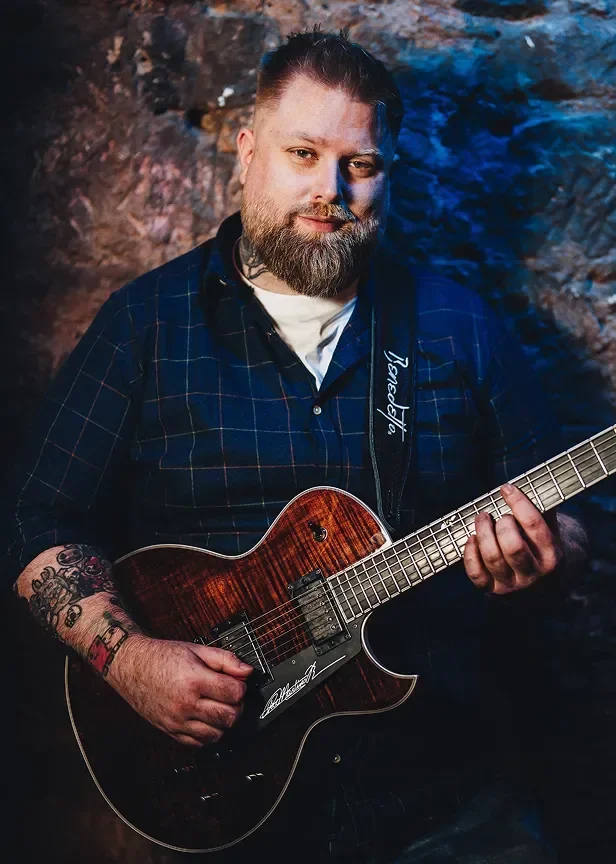
I first found you through your Guitar Pro videos, and I learned a ton from them. Guitar Pro has become one of the best tools in my own workflow for transcribing. For someone who’s never tried to transcribe anything before, what should they start with, and what are a couple things they should focus on early to start building good habits?
That’s a great question! And the answer really splits in two directions, both how to learn to transcribe, and how to use Guitar Pro!
The thing I always tell my students is that transcribing is reading in reverse. You’re hearing a sound and knowing what it should look like when you put it on the page. To be good at that, I encourage them to learn about reading. If you can’t see something on the page and know what it should sound like, it’s going to be hard to hear it and know what it looks like!
That sounds scary, but the only side of it you REALLY need to work on is rhythm reading. That’s where guitarists fall down, they can find the notes, but not the “when”, you shouldn’t trial and error that. I conceptualize it before I write it down. There are lots of good books on that, but the William Leavitt Melodic Rhythms For Guitar is a must have for studying reading rhythm in an effective way.
Then it’s learning Guitar Pro. People jump in and just assume they’ll work it out. Don’t. Start with a tab book, take a song and copy it into Guitar Pro. Doing that will teach you everything you need to know, and you can solve each problem as you go.
You’ve written some of my favorite guitar books and have transcribed for some incredible players. I know you’ve also co-written and ghost-written with some of your childhood heroes. What’s that process like when you’re putting it all together for someone whose playing shaped you growing up?
Oh man! Yeah, that’s a half icky thing. When people read an article by a famous guitarist they assume it’s directly from the artist, and it may be... but the truth is, it isn’t always. That’s not to say the artist wasn’t involved, but just as not all great players are great teachers, very few great players are good writers. When I work with an artist on their work where I’m doing the text, it’s about getting in their head. Know their playing, speak like them. It’s never about putting words in their mouth, they’re not a conduit for your teaching, it’s about extracting the information from them.
Albert Lee is a good example, he has that instructional video where he’s being interviewed. He needs someone to extract it from him. I know his playing well enough that I could ask him questions to make his mindset clearer. He wouldn’t use terms like CAGED, but when you break down how and where he plays... it’s chord forms. So knowing the player helps. I would only do that for someone I know well as a player. If someone needed me to ghost write something for Josh Meader? I’d pass, because I’m not in his head. But I’ve been lucky enough to work with (as you say) some of my childhood heroes. Once you get over the shock of “oh wow... I’ve loved this guy since I was 14”, it becomes easy!
When you’re not working on teaching others, what do you actually sit down and practice on your own guitar?
Ahhh! You would think that running a site like Guided Practice Routines I’d be practicing ALL the time... but in reality I’m not putting in the hours on guitar like I used to. I put my hours into my ears. In the last month I made my Science Of Chord Progressions course, and for that I wanted to transcribe a bunch of songs so people could see common chord progressions. I did 350 songs for that. And as I started playing piano 5 years ago, that’s my main focus now. Transcribing 350 songs at the piano is amazing practice! What’s what? This one is in Gb? I guess I better know that key really well!
Beyond that, it’s all harmony on the guitar. Voice leading exercises, chord work. When I gig it’s 95% chords, so I owe it to myself to have a fraction of the chops as a gospel piano/organ player!
It seems like CAGED has played a big role in your progression on guitar, and I’ve really enjoyed watching you break the system down into fewer shapes on your teaching platform. I think it’s funny that people are still going back and forth about CAGED vs. 3 notes per string and all that. What’s your take on that debate, and has your own thinking on any of it changed over the years?
It’s funny, I got known as a CAGED guy because in my early career I spent a lot of time debunking the shitty marketing of other teachers who relied on fear to sell you the only thing they had.
I was a 3nps player. I grew up on Paul Gilbert and Jason Becker. I didn’t touch CAGED until I was in my very late teens, and I did so because I HAD to for school. I tried to fake it and convert everything, but here’s the thing about learning... you take lessons from people who know more than you. One day I had a lightbulb moment where the brick walls the 3nps system put me against were broken down by CAGED knowledge.
It makes me sad to see people with influence talking trash about things you KNOW they don’t actually know. They just know what they use and therefore it MUST be the best way... and sure, maybe you can play really fast, but can you play over changes? Not just run patterns and hope nobody notices. Can you play the right sounds over chords. Can you target extensions?
Knowledge is power. Know more. I’ve never regretted learning something, and never relied on trashing something I don’t do to sell myself. If I don’t know about it, I go and learn!
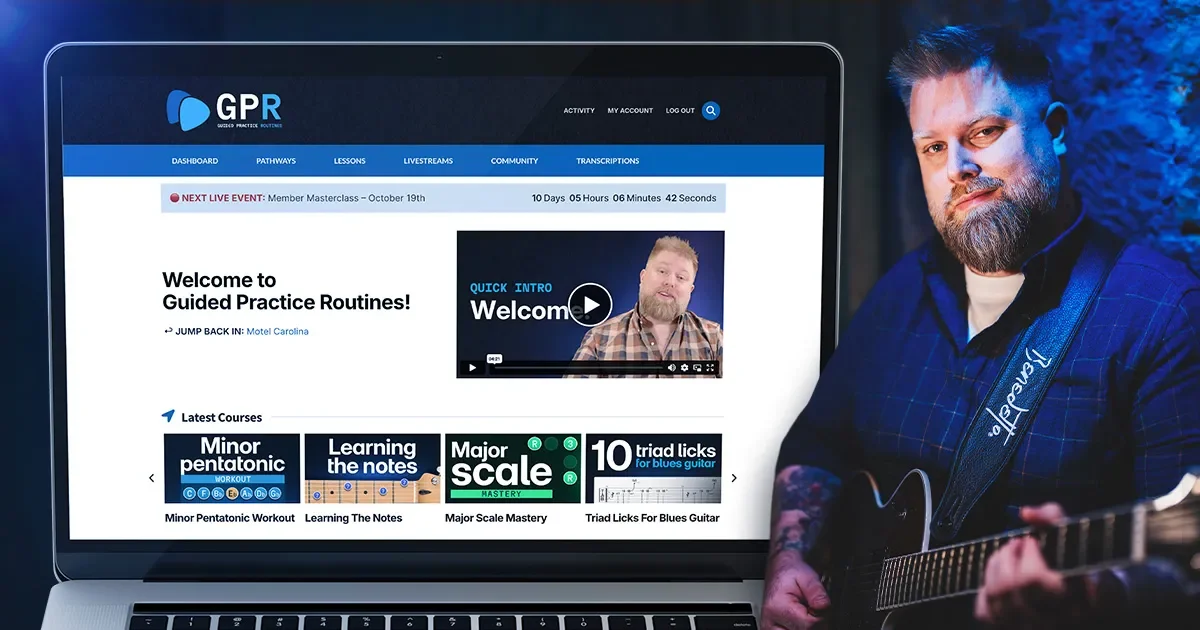
You built Guided Practice Routines after decades of teaching and meeting tons of students who didn’t have structure in their practice. What does a student’s playing actually look like after 10 weeks on the platform compared to when they started? Any sneak peeks on what’s coming up for GPR?
I’m not ashamed to point to where I learn things and where I get ideas. I mentioned William Leavit earlier, and my ACE system (an offshoot of CAGED) is what I learned from Mick Goodrick. I don’t think it makes you look derivative, it’s academia, it gives you gravitas.
GPR was born from two things. Learning the piano was a big one. Remembering that you have to put in the time and repeat all the boring stuff. I’m an Open Studio Jazz Pro member and they do a Daily Guided Practice Session. I loved them. But daily was just too much when you’re also trying to learn. So I took that and my memories of Frank Gambale’s Chopbuilder... and BOOM. Weekly Guided Practice Routines on Patreon.
It’s hard to say what 10 weeks looks like though because after doing that for a couple of years It occurred to me there’s a HUGE difference between learning something, and practicing it. And so many people use GPR as a way to learn the thing. That’s fine, but for every hour it takes to learn a thing, you need to practice it for 10. It will come as no surprise to you, but every routine I post on the site is all stuff I know and find easy, so for me it really is practice when I do it. Just like a pianist warming up with scales. He’s played them for 50 years... why is he still practicing them? Because that’s how we get better. Not just looking for the next thing to learn, but really wanting to master the things you learn.
What I can say is that if after 10 weeks on GPR where you’ve put in the time, you’re not a totally different player, then you’re in the minority. I often say it, but very little of GPR is sexy, but it’s all stuff you should be better at, and if you’re honest, you know you aren’t. So let’s practice. Together.
What music is getting you excited right now? Whether you’re studying it, transcribing it, or just putting it on and listening for fun.
I still listen to a huge variety of music, but in the last 5 or so years I remembered why I started playing music, and it was songs. Not solos. I’m not one of those guys who scrolls instagram looking for the next killer 30 second clip. I listen to songs. I think Stevie Wonder is one of the greatest to ever do it. I also have a major love for Randy Newman’s songwriting. When it’s not old music, some new bands I love are Lawrence, Lake Street Dive, and Sammy Rae & The Friends. I almost feel like a real musician now because there’s three great bands, but if you put a gun to my head... I could not tell you any of their guitar players. I hear what they play and how they contribute, but the song wins.
I’m sure you want some guitarists though, so I’ll throw some love to some killer players people may or may not know. Cecil Alexander, Kent Crawley, Dan Wilson, Donnie Bell, Eric Zolan.
You didn’t pick up the guitar until your early teens. If that kid from Ipswich walked into your practice room today as a brand new student, knowing everything you know now after 20 years of teaching - what’s the first thing you’d want him to understand about the instrument?
How Very Brad Paisley “letter to me”!
That’s easy! Work on those ears kid! The guitar is such a cool instrument, and it’s one of very few that you play harmony on, but compared to the keyboard, we ain’t shit. And the organ? Those cats have 10 fingers AND foot pedals. A guitarist who thinks he hears chords is cute. I know people think of me as being some kind of ear master, but compared to a great keys player, I have nothing. I’m limited by 6/7 strings and my range. So learn harmony. Learn triads on the guitar really well. Know chords inside and out because chords are just like a snapshot of time, lines are those snapshots played over time. You’re never above learning. No matter where you are, find someone better and learn from them. In the last few years I’ve worked with Tony Monaco as my organ teacher and Noah Kellman on piano. Sure, it’s nice to be humbled, but it just keeps driving you to get better!
20 years ago I was a guitar teacher, but now I’m a music teacher. It might not always be easy to find a great guitarist near you, but find a great musician and learn from them!
Levi, I can’t thank you enough for your incredibly thoughtful and fun answers. I think everyone reading this will be inspired and have a ton of great guitar-related things to work on. Speaking of which, everyone should check out Levi’s Guided Practice Routines platform, and subscribe to him on YouTube. Thanks Levi!